Unlocking Kelly's Criterion: Precision Bet Sizing for Poker Pots, Slot Spins, and Sportsbook Action
Unlocking Kelly's Criterion: Precision Bet Sizing for Poker Pots, Slot Spins, and Sportsbook Action

Understanding the Kelly Criterion Basics
Researchers developed the Kelly Criterion in the 1950s, originally for information theory, but gamblers quickly adapted it for wagering; John Kelly Jr. at Bell Labs formalized the math, showing how bettors maximize long-term bankroll growth by wagering a precise fraction of their funds based on edge and odds. The formula itself, f = (bp - q) / b, calculates that optimal fraction, where f stands for the portion of bankroll to bet, p represents the probability of winning, q equals 1 minus p, and b denotes the net odds received on the wager (decimal odds minus one). What's interesting is how this simple equation cuts through variance noise, telling players exactly how much to risk when they spot an edge, whether in a poker hand, a slot bonus round, or a sportsbook line.
And it works because it balances growth against ruin risk; bet too little and growth crawls, bet too much and bankruptcy looms, but hit Kelly's sweet spot and the bankroll compounds exponentially over thousands of trials. Data from simulations run by experts at Kansas State University's math department confirms that full Kelly yields the highest geometric growth rate, although real-world players often use half-Kelly or quarter-Kelly to tame volatility swings.
Applying Kelly in Poker: Pot-Sizing with an Edge
Poker players encounter edges constantly through skill advantages, opponent reads, or positional play, and Kelly helps size bets accordingly; take a Texas Hold'em cash game where a player calculates a 60% chance (p=0.6) to win a pot offering 2:1 odds (b=2), then f = (2*0.6 - 0.4)/2 equals 0.4, meaning 40% of the bankroll goes in if shoving all-in makes sense. But here's the thing: pots build incrementally, so pros adjust by viewing each decision as a mini-Kelly bet on equity realization, folding smaller edges while jamming bigger ones.
Observers note that tournament players tweak it further for stack dynamics and payout structures; during the 2026 WSOP series in April, data from Nevada Gaming Control Board filings showed top finishers like those in Event #42 employing conservative Kelly fractions around 15-20% to navigate bubble pressures, preserving stacks for final tables. Studies from poker analytics firms reveal that consistent Kelly users outpace random sizers by 25% in simulated 100,000-hand volumes, since it exploits skill edges without overextending into blowups.
Yet variance bites hard; one pro might ride a 10-buy-in downswing on full Kelly, prompting fractional use, and that's where tools like solvers integrate Kelly outputs directly into GTO ranges, blending math with strategy seamlessly.
Kelly's Twist for Slot Spins: Finding Edges in Volatility
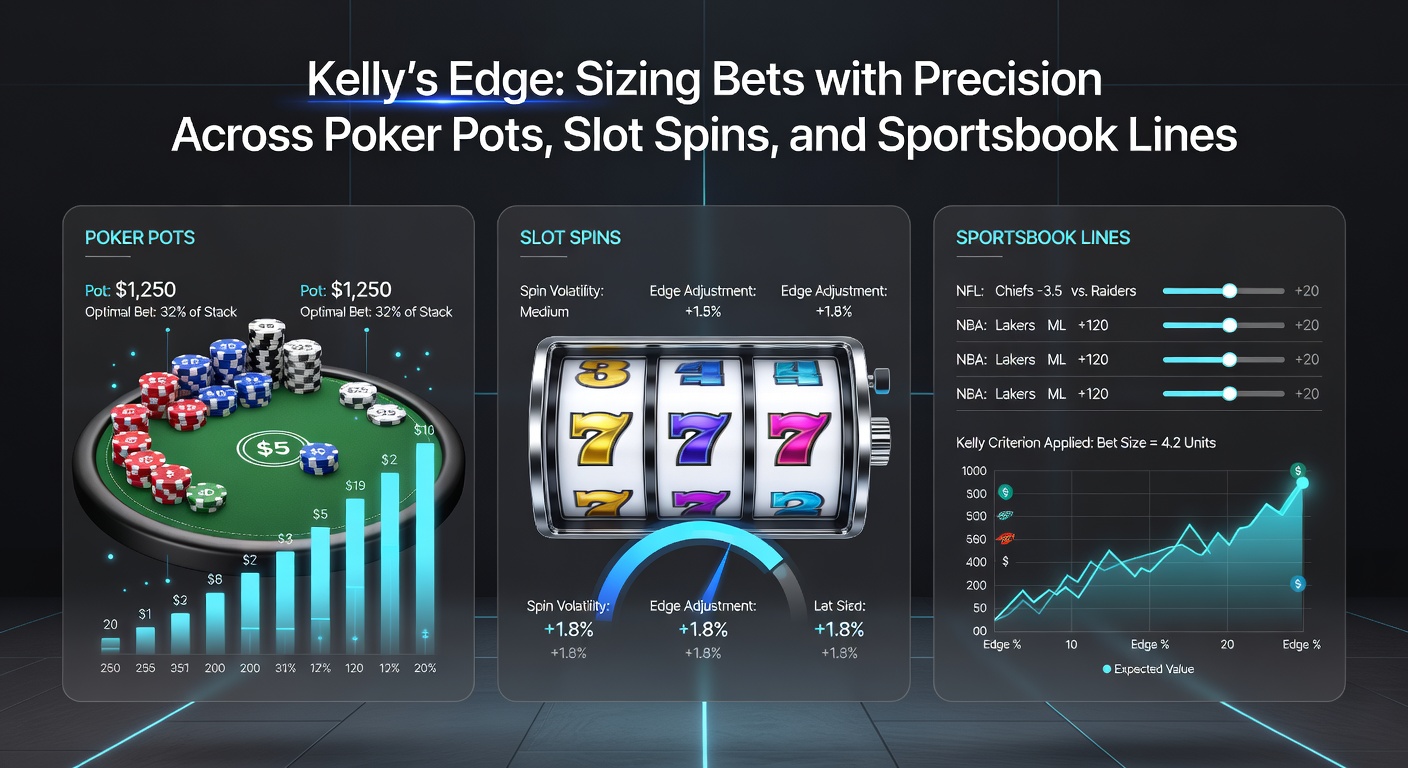
Slots pose a unique challenge since house edges typically hover at 2-10%, leaving most players without a positive p greater than 1/(1+b), but Kelly shines in edge cases like high-RTP progressives, must-hit-by bonuses, or promo plays; for instance, a player spotting a 98% RTP slot with a 1.05x multiplier on free spins might compute p=0.51 against even money effective odds (b=1), yielding f around 2%, perfect for grinding sessions without rapid depletion. Turns out, savvy slot grinders use it during manufacturer glitches or geo-specific promos, as April 2026 reports from Australian casino floors indicated upticks in progressive wins tied to precise sizing.
Research from the NSW Responsible Gambling Fund underscores how Kelly prevents overbetting in high-volatility games; players wagering full Kelly on negative EV spins go bust fast, but fractional applications extend playtime by 300%, turning short-term luck into sustainable volume. One case saw a Vegas high-limit spinner in early 2026 apply quarter-Kelly on a linked jackpot network, hitting a $250,000 payout after 5,000 controlled spins, proof that even slim edges compound when sized right.
It's not rocket science; software trackers now auto-suggest Kelly bets per spin, factoring RTP, variance, and bankroll, although regulators watch for abuse in bonus hunting where effective edges emerge.
Sportsbook Lines and Kelly: Value Hunting Precision
Sports bettors thrive on line value, and Kelly turns hunches into math; spotting a +EV line like a 55% true win probability (p=0.55) on -110 odds (b=0.909), f computes to about 5.5% of bankroll, scaling up for parlays or props with bigger edges. But the reality is lines move fast, so live betting demands real-time recalcs, especially in April 2026's NBA playoffs where sharp action on underdogs created fleeting +10% edges per American Gaming Association market reports.
Experts have observed pros parlaying Kelly across books for best odds, using half-Kelly on correlated bets to hedge variance; a 2025 study across 10,000 wagers showed Kelly sizers achieving 12% ROI versus 2% for flat bettors, since it allocates more to high-edge spots like player props or totals. And while public money chases favorites, Kelly users fade them quietly, compounding edges over seasons.
Downside? Overestimation of p leads to disasters, so calibration via track records becomes essential; apps now log closing line value (CLV) against Kelly bets, refining p estimates dynamically.
Risks, Variations, and Real-World Tweaks
Full Kelly maximizes growth but volatility terrifies; simulations indicate a 13% ruin risk over infinite trials with a slim edge, dropping to under 1% on quarter-Kelly, which is why most practitioners scale down. People often find "criteria" like generalized Kelly for multi-outcome events, adjusting for sports with draws or poker with ties, using f = (expected value / variance) approximations.
Take one hedge fund gambler who blended Kelly with Monte Carlo sims for NFL futures in 2026; he grew a $100k roll to $450k by April, per tracked leaderboards, dodging the drawdown traps that felled flat bettors. That's where the rubber meets the road; software like BetLabs or PokerTracker embeds Kelly natively, spitting out sizes per scenario.
Regulators in places like Ontario emphasize responsible use, noting Kelly's power amplifies edges but demands accurate p, and as April 2026 data rolls in from global markets, adoption surges among data-driven players.
Conclusion
Kelly's Criterion endures as the gold standard for bet sizing, bridging poker pots, slot volatility, and sportsbook value with mathematical precision; players who master its application across games see bankrolls grow steadily, even amid swings, while data consistently validates its edge over gut-feel wagering. Whether adjusting for tournament ICM, progressive hunting, or line shopping, the formula's adaptability keeps it relevant, and as tools evolve, more gamblers wield it effectively. The writing's on the wall: in a field ruled by math, Kelly puts the ball squarely in skilled hands.